Why key person risk narrows sale options and how operational maturity changes the picture
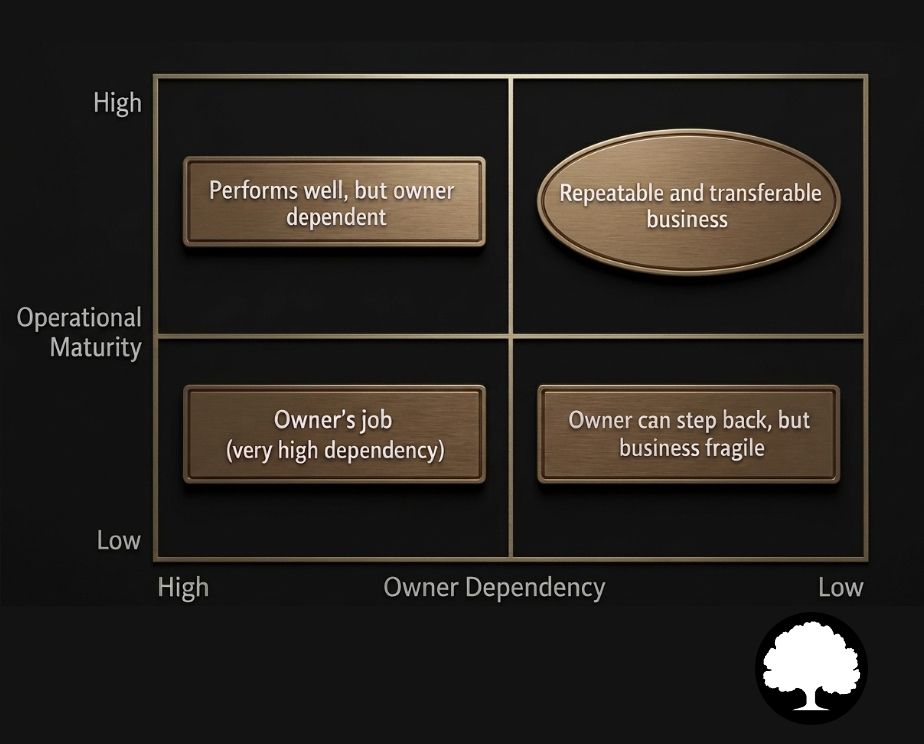
Many owner-led businesses perform well, but still carry a level of owner dependency that can reduce buyer confidence and limit sale options. The model above helps show why. It is not enough for a business to grow well. To be truly transferable, it also needs the operational maturity to perform without relying too heavily on one individual.
For many owners, who are often also the founder, the business has been built through personal drive, deep customer relationships and years of hands-on decision-making. That is often what got the company to where it is today. But when the time comes to think about succession, investment or sale, those same strengths can begin to create risk.
This is where key man risk becomes a serious issue.
If too much of the business depends on one person, buyers do not just see leadership. They see concentration of knowledge, concentration of relationships and concentration of operational control. In other words, they see fragility. And fragility affects value, deal confidence and the range of options available.
The model helps bring that into focus.
On the left-hand side, owner dependency is high. In the lower-left quadrant, the business is effectively still the owner’s job. The owner may be central to sales, delivery, customer management, staff decisions and problem-solving. This kind of business can still be profitable, but it is very hard to transfer with confidence because too much sits in one pair of hands.
In the upper-left quadrant, the picture is stronger, but still challenging. Here, the business performs well but remains owner dependent. Revenue may be good. Customers may be loyal. The business may even have a strong reputation in the market. But if the owner is still the person holding key relationships, carrying critical knowledge or making too many decisions, buyers will still question how well performance holds once that individual steps away.
That is where options begin to narrow.
Acquirers are not simply assessing what the business has done in the past. They are assessing how durable and transferable that performance will be in the future. They want confidence that the business can continue to operate, deliver and grow without relying on the same owner intensity that currently exists.
This is why reducing owner dependency matters, but it is only part of the story.
The bottom-right quadrant in the model is an important reminder that an owner stepping back does not automatically mean a business is sale-ready. It is possible for owner dependency to reduce while the business remains operationally fragile. Processes may still be informal. Roles may still be unclear. Standards may vary across the organisation. That business may be less dependent on the owner day to day, but it is not yet truly resilient.
The goal is the top-right quadrant: a repeatable and transferable business.
This is where low owner dependency and high operational maturity come together. The business runs through clear processes, strong systems, defined accountability and capable teams. Knowledge is shared. Customer relationships are broader. Decision-making is not concentrated in one person. Performance becomes embedded in the business itself rather than held together by owner effort.
That is what changes the picture for buyers.
A repeatable and transferable business is easier to understand, easier to diligence and easier to back. It gives acquirers greater confidence in continuity after a transaction. It often opens up a broader set of buyer conversations, creates stronger negotiating positions and supports better outcomes on both value and deal structure.
This is also why the timing matters.
Operational maturity is not something that can usually be built in the final few months before a sale. It takes time to strengthen leadership layers, document ways of working, improve reporting, create accountability and reduce over-reliance on the owner. The earlier that work begins, the more real and sustainable the change becomes.
For owners, that creates benefits well before any transaction. The business becomes more resilient. It can cope better with growth, pressure and change. The owner has more freedom. And when the time does come to explore a sale or succession route, the business is in a much stronger position.
Put simply, businesses rarely become more attractive at exit by accident. They become more attractive because the right foundations were built early enough.
The model is a simple one, but it reflects an important truth. Businesses do not move from owner-dependent to transferable through good intent alone. They move by building the operational maturity that allows performance to sit in the business, not just in the owner.
That shift is often what turns a good business into a genuinely transferable one.
If you are thinking about succession, exit or simply reducing owner dependency, reach out to us for a conversation.